
What Is the Founder Bottleneck? The Stage Where Businesses Get Stuck
You built a real business where you have revenue and customers coming in. You know there’s demand.
But the business still depends on you for almost everything. Every major (and let’s be real most minor) decision runs through you. Things are often waiting on you.
Your growth is creating more complexity instead of more freedom.
If this feels familiar, then you’ve reached a stage many founders experience but very few people talk about.
It’s called the Founder Bottleneck.
Many founder-led businesses hit this stage once they move beyond early traction but before the business has developed the systems required to scale.
This stage is usually the moment founders realize the problem isn’t effort, motivation, or marketing.
It’s how the business is structured to grow.
What is the Founder Bottleneck?
The Founder Bottleneck occurs when a business has demand and is increasing revenue but still relies heavily on the founder to make most decisions, solve operational problems, and drive growth.
As the business expands, this dependency only creates more complexity.
This usually ends up looking like decisions piling up, priorities and strategies becoming unclear. This often ends up slowing progress and growth even though the business owner feels busier than they’re ever been before.
Most founders assume this stage means they need either better marketing or more leads.
But the issue is usually a growth architecture problem. The business structure hasn’t evolved to support the level of growth.
Founder-led businesses typically move through three stages of growth. The Founder Bottleneck sits right in the middle.
The three stages of founder-led business growth
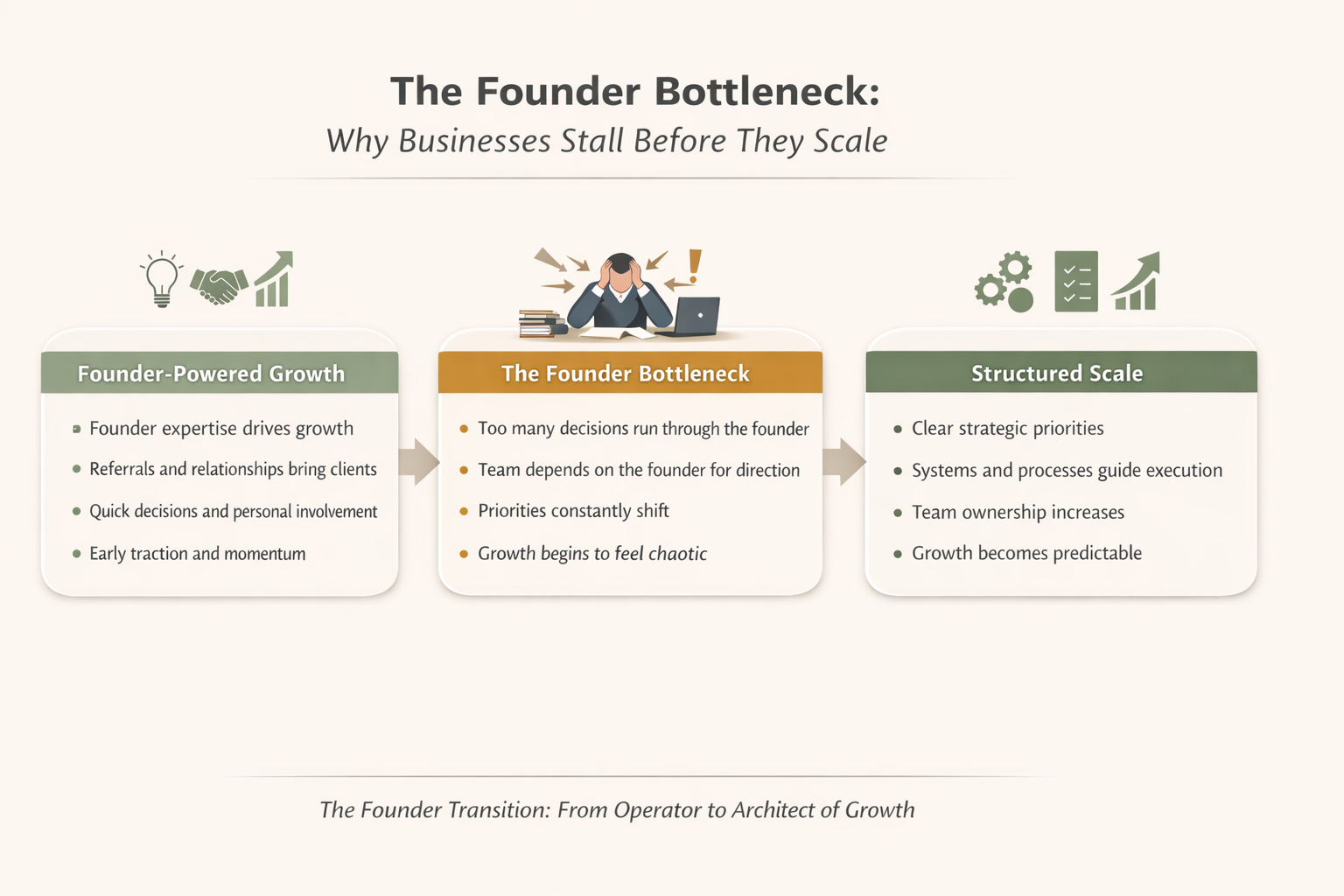
This framework illustrates the Founder Bottleneck — the stage where founder-led businesses stall because too many decisions depend on the founder before systems and structure are built.
Most founder-focused businesses follow a similar path where early growth happens fast because the founder can effectively build community and trust. But over time, that same dynamic becomes the thing that can actually limit growth.
Think of founder-led growth in three stages.
Stage 1: Founder-powered growth
In the early stage of a business, the founder drives almost everything. Their growth comes from expertise, relationships, and reputation. So customers usually come from referrals, networking, or personal visibility.
Marketing tends to be straightforward because the founder is so effective at speaking directly to their community and building an audience.
At this stage, founder involvement isn’t a problem, it’s an asset. The business is still small enough that one person can manage most decisions and tasks.
For many founders, this stage feels exciting and energizing because progress happens organically and quickly.
Stage 2: The Founder Bottleneck
As revenue grows, complexity and needs grow with it. More customers and more work require more planning and coordination. And these new opportunities create competing priorities.
But the structure of the business often stays exactly the same with the founder still responsible for strategy, operations, marketing, and major decisions.
So instead of creating leverage, their growth creates more pressure. And this is the Founder Bottleneck stage.
The founder becomes the central point through which everything flows. So progress now depends on how much the founder can manage and this can get complicated, fast. Especially for founders who are balancing other areas of their life, family, kids, etc.
This is also the stage where many businesses start to feel chaotic.
Stage 3: Structured scale
Businesses move beyond the Founder Bottleneck when they rework how the business operates and how they work within the business. This means growth no longer relies on the founder doing almost everything.
Instead, the business runs through foundational strategies, systems, priorities, and clearly defined roles.
This results in operational processes becoming repeatable and the team knowing how to execute without waiting for constant direction from someone else.
The founder transitions from operator to strategic leader and if applicable, the face of the brand.
This stage is where growth becomes more stable and predictable.
5 signs you are entering the Founder Bottleneck
Most business owners don’t recognize the Founder Bottleneck right away. But they do start to notice the symptoms that start to appear as the business grows.
Here are some of the most common signals.
1. Every important decision still runs through you
Your team can’t move forward without your input and even relatively small decisions require your approval or feedback.
Over time, this slows down the entire business.
2. Your team constantly waits for direction
People want to support you and do good work, but they’re not sure what the priorities are.
Without a foundational strategy, clear systems, or decision frameworks, the founder becomes the default source of direction that everyone turns to with questions.
3. Your workload keeps increasing
Growth was supposed to create more freedom for you as a business owner. But now it feels like you’re working more hours and juggling more responsibilities than ever before.
4. Priorities change frequently
When everything depends on the founder, priorities tend to shift based on the most urgent or recent problem.
This means the founder and the business becomes reactive instead of strategic.
5. Growth feels chaotic and exhausting instead of exciting and fulfilling
More customers and more revenue should feel like progress. But during the Founder Bottleneck stage, growth usually creates more stress than stability.
Many founders start to feel like the business is running them instead of the other way around.
Why founders misdiagnose this problem
One of the biggest challenges with the Founder Bottleneck is that business owners tend to mistake it as a marketing issue.
“We need more traffic.”
“Our marketing stopped working.”
“Our content isn’t converting anymore.”
Sometimes marketing improvements are helpful. But many times, the real issue is that the business architecture hasn’t evolved alongside the growth.
Marketing can absolutely generate demand. But the business still needs the strategy and structure to support that demand.
For example, a business might generate strong visibility through content, SEO, or advertising but struggle operationally once demand increases.
Marketing is only one layer of how a business grows. To scale sustainably, businesses need to align visibility, strategy, and operations. For a deeper explanation of this concept, see How Businesses Scale: The Growth Architecture Most Founders Are Missing.
Why businesses often stall around the same revenue stage
Many founder-focused businesses encounter the Founder Bottleneck somewhere between early traction and structured scale. Which is why so many owners report feeling stuck between roughly $150,000 and $500,000 in annual revenue.
Growth creates complexity faster than the business can adapt to handle it. So more customers create more delivery work and coordination while more visibility creates more expectations.
Without stronger foundational strategy, systems, and priorities, the founder becomes the limiting factor. If you want a deeper look at why this happens, see Why Your Business Stopped Growing (And Why It Happens Around $150K–$500K).
How businesses move beyond the Founder Bottleneck
Moving beyond the Founder Bottleneck requires redesigning how the business supports growth. And this usually means making three major shifts.
First, the business must clarify its growth priorities.
Founders often pursue too many initiatives at once. Clear strategic priorities make it easier for teams to focus and execute effectively.
Second, the business must develop stronger operational systems.
Processes, documentation, and workflows allow work to happen consistently without relying on the founder's memory or constant oversight.
Third, the business has to strengthen its visibility systems.
Marketing should operate as a repeatable system that consistently attracts the right audience and customers.
These three areas create what I call the Growth Architecture of the business. When the layers work together, the business can grow without everything depending on the founder.
The real transition: from operator to strategic leader
One of the biggest changes during this stage is the role of the founder.
In the beginning, founders operate as the engine of the business. They’re involved in every project, marketing initiative, and operational decision.
But as the business grows, this setup stops working.
To scale effectively, the founder has to shift from being the primary operator to becoming the strategic leader of the business.
This means focusing more on:
strategic priorities
team leadership
growth direction
founder-led content
It’s not about doing less work. It’s about doing the right work.
FAQ
What is the founder bottleneck?
The founder bottleneck occurs when a business relies heavily on the founder to make decisions, drive growth, and manage operations. As the company grows, this dependency slows progress and makes scaling difficult.
Why do founder-led businesses struggle to scale?
Founder-led businesses often struggle to scale because early growth relies on the founder's expertise and personal involvement. Without systems and clear operational structure, growth becomes difficult to manage.
Is the founder bottleneck normal?
Yes. Many businesses experience this stage as they transition from early traction to structured growth. The challenge is recognizing the stage and adapting the business strategy and structure accordingly.
How do founders move beyond the founder bottleneck?
Founders move beyond the founder bottleneck by establishing foundational strategy, building systems, clarifying priorities, and developing operational structures that allow the business to grow without requiring the founder to handle every decision.
Final thoughts
The Founder Bottleneck is one of the most common stages in founder-led businesses. And it usually shows up at the exact moment when a business should be gaining momentum.
The good news is that it’s not a sign the business is failing. It’s a sign the business is evolving.
The challenge is recognizing when the foundational strategy and structure of the business needs to evolve along with it.
If your business feels stuck in this stage, the first step is identifying where the real constraints are.
If this sounds like your business, Scaling with Both Sides of AI is a free monthly training on the same problem: why the work still routes through you even with AI in the mix, and what to change first.
It's 45 minutes, it's free, and you'll leave with one thing to do this week.