
How AI Search Is Changing How Customers Find Businesses
Founders keep telling me their marketing "just stopped working."
Most of the time, it didn't. The ground shifted underneath it.
Search is no longer a list of links. Tools like ChatGPT, Google AI Overviews, and Perplexity now generate answers directly inside the search experience, often without sending users to any website. Google's AI Overviews reach 2 billion monthly users across 200 countries and territories, and they now appear on nearly half of all Google searches as of Q1 2026. ChatGPT alone crossed 900 million weekly active users in February 2026. 73% of B2B buyers now use AI tools in purchase research.
Those numbers represent a meaningful share of customers who may never see your business in a traditional search result, no matter how strong your SEO is.
For founder-led businesses, the implication is simple. Getting discovered online used to mean ranking on Google. Now it also means showing up inside AI-generated answers — both as a cited source and as a recommended business.
What is AI search?
AI search is search that uses artificial intelligence to summarize answers and recommend businesses across the web instead of returning a list of links.
The major AI search tools right now:
Google AI Overviews
ChatGPT and ChatGPT Search
Perplexity
Claude
These tools synthesize information across multiple sources and deliver a structured response inside the search experience itself. For users, that means faster answers and more curated recommendations. For businesses, it means visibility now works on a different set of rules than it did even two years ago.
Why ranking #1 is no longer the whole story
Traditional SEO was a competition for clicks. If your page ranked well, users clicked through to your site.
AI search compresses that loop.
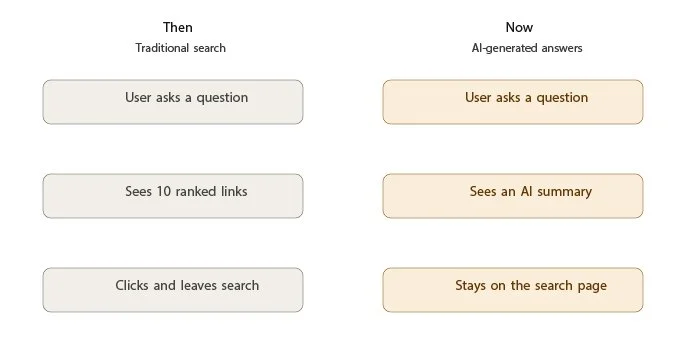
Instead of sending users to ten different websites, AI tools synthesize the information and deliver a single answer at the top of the page. Users often get what they need without ever leaving the search experience. Seer Interactive found that organic click-through rates dropped 61% on queries where an AI Overview appears, from 1.76% down to 0.61%. Across the publishing industry, portfolios with significant informational-query exposure are seeing 30 to 70 percent click drops, with rankings holding flat.
Read that again. Rankings holding flat. The position you earned is still there. The click is the part that disappeared.
That's the shift catching founders off guard. Their SEO didn't break. The interface absorbed the click before their position got a chance to earn it.
The new question is whether AI tools surface you when someone asks about your topic, your service, or your industry. And there are two distinct ways that can happen.
Two types of AI search visibility
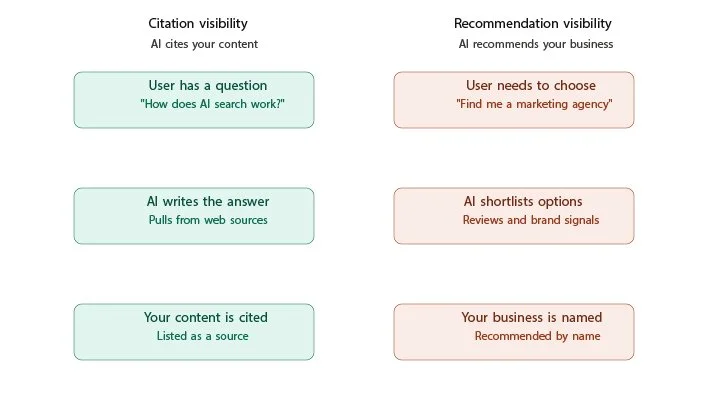
AI search visibility shows up in two different forms, and they require different optimization approaches.
Citation visibility
Citation visibility is when AI tools pull from your content and cite you as a source when generating an answer to a general question.
Example: someone asks ChatGPT "how do AI search tools decide which sources to cite?" and the response includes a summary of your blog post on the topic, with your site listed as a cited source. Your content shows up inside the answer. The signals that drive citation visibility are mostly about the content itself — how it's structured, how authoritative the source is, how recently it was updated.
Recommendation visibility
Recommendation visibility is when AI tools name your business specifically as a recommended option when a user asks for help choosing.
Example: someone asks ChatGPT "find me a marketing agency that works with health and wellness brands" and the response names three or four specific agencies — and your business is one of them. The signals that drive recommendation visibility are mostly about the brand itself — how often you're mentioned across the web, what reviews say about you, how clearly your positioning matches the user's query, and what AI tools already know about the person asking.
That second piece matters more than most founders realize. AI tools factor in everything they know about the user — stated profession, location, past queries, preferences — and tailor recommendations accordingly. A founder asking ChatGPT for a marketing agency gets different recommendations than an enterprise CMO asking the same question.
Why both matter
Most businesses optimize for citation visibility (because that's what SEO experts mostly talk about) and miss recommendation visibility entirely. The two compound when they work together. Citation visibility tells AI tools you know your subject. Recommendation visibility tells AI tools you're a real business worth pointing customers toward. The businesses winning right now are showing up in both places.
How AI tools decide which content to cite
AI systems aren't pulling content randomly. Four signals consistently determine which content gets cited.
Structured content
AI tools summarize from the top down. Articles that open each section with a clear one-sentence answer (followed by supporting context) get extracted. Articles that bury the answer in paragraph three rarely do, even when the content is excellent.
Topical authority
If your site consistently publishes about a specific subject, AI tools learn to associate your business with that topic. One blog post on a subject does almost nothing. A sustained body of work over time shifts how AI systems classify you.
Author and citation signals
AI tools weigh signals of trust. A real author bio with credentials. Original frameworks. Specific examples and data. Citations to other authoritative sources. These were always best practices. They're now a visibility requirement.
Recency
AI tools heavily favor information that's current. For fast-moving topics, regular updates matter as much as the original publication.
How AI tools decide which businesses to recommend
Recommendation visibility runs on a different set of signals than citation visibility. AI tools approach "find me / recommend me" queries the way a careful buyer would — by checking what the rest of the internet says about a business before pointing someone toward it.
Brand mentions across the web
When AI tools evaluate which businesses to recommend, the most important signal is how your business shows up in third-party content. Industry articles, podcast features, guest posts, news mentions, comparison roundups, and even social conversations all build what could be called your AI training footprint. The denser and more consistent your presence across reputable sources, the more likely AI tools are to recognize you as a real business in your category.
Third-party reviews and directory presence
Review and directory platforms carry significant weight in recommendation visibility. For B2B businesses, ChatGPT leans heavily on aggregator signals from platforms like G2, Capterra, and TrustRadius. For local and service-based businesses, Google Business Profile, Yelp, and industry-specific directories matter the most. Active review presence on multiple platforms is one of the highest-leverage moves a founder-led business can make for AI visibility.
Sharp niche positioning
Generalist positioning loses to specific positioning every time in AI recommendations. When a user asks AI for "a marketing agency for health and wellness brands," AI tools surface businesses whose entire web presence reinforces that exact niche. Vague positioning ("we help all kinds of businesses grow") gives AI tools nothing to match against.
User context and contextual signals
This piece often surprises founders. AI tools factor in everything they know about the user — their stated industry, location, past conversations, preferences — when generating recommendations. The implication is significant. The clearer your positioning around a specific audience, the more likely AI tools are to surface you when that audience asks for help. Niche businesses gain ground here, not lose it.
Schema and entity signals
The technical layer still matters. Organization schema, LocalBusiness schema, and consistent name/category information across your website and external profiles tell AI tools exactly what category your business belongs in. Without these signals, AI tools have to guess. Most of the time, they guess in favor of the competitor with cleaner data.
Where AI search visibility fits in Growth Architecture
AI search visibility is a layer inside a larger system, not a standalone tactic.
In our [Growth Architecture] framework, that layer is called Visibility Architecture, and it covers all the systems that determine how the right people find your business. Visibility Architecture includes:
search engine optimization
AI search visibility (citation and recommendation)
content marketing
authority positioning and brand mentions
partnerships and collaborations
advertising
Visibility Architecture is one of three core systems behind scalable growth. The other two are Strategy Architecture (how the business decides what matters) and Operational Architecture (how the business delivers work). When all three are aligned, growth becomes predictable.
When visibility lags behind, opportunities slow. As AI search continues to grow, businesses that haven't adapted their visibility systems quietly lose ground without ever knowing why.
Why this matters for founder-led businesses
Most founder-led businesses I work with built their early growth on referrals and personal networks, then layered in SEO and content marketing as they scaled. That sequence works well until the broader search environment shifts under it.
Lately I've been hearing the same thing from founders:
"Nothing's changed in our marketing. Our rankings are still where they were. But the inquiries have just dried up and I can't figure out why."
That experience is showing up across the industry. Reuters Institute's 2026 survey of 280 media leaders found that global publishers saw Google referral traffic drop by roughly a third in 2025, with AI summaries cited as a major contributing factor. HubSpot lost 70 to 80 percent of organic traffic between November 2024 and Q2 2025.
At the same time, 35% of consumers now use AI tools at the discovery and initial ideas stage of research, compared to 13.6% using traditional search at the same stage. The buyers are still out there. They're just looking somewhere else first.
The shift isn't loud. It's just steadily widening the gap between what businesses are doing and what's actually working.
The good news: most of what improves AI search visibility also strengthens traditional SEO and reader experience. The work compounds.
How to improve your AI search visibility
Adapting to AI search doesn't require a completely new marketing playbook. It requires sharpening how existing content is structured and how your brand shows up across the web.
To get cited
Open every section with the answer. The first sentence of each H2 is what AI tools are most likely to summarize. Lead with the answer. Save the context for the second sentence. Most posts bury the answer three paragraphs down, then wonder why they're not getting cited.
Pick one subject area and go deep. A scattered blog covering ten unrelated subjects gives AI tools nothing to anchor to. A focused body of work that consistently addresses related questions inside one subject area builds the topical authority AI tools reward. This is also where Strategy Architecture matters. Without strategic clarity on what you want to be known for, content stays scattered.
Refresh your highest-performing posts. Information that's two years old gets cited less often, especially in fast-moving subjects. Pick your top five highest-traffic posts. Update them quarterly. The performance gain is disproportionate to the effort.
To get recommended
Build your brand footprint across third-party sources. Guest posts on industry blogs. Podcast appearances. Features in roundup articles. Quotes in trade publications. Each one adds another signal that helps AI tools recognize your business as a real player in your category. This is the slowest-compounding work but the highest-leverage one over time.
Get active on review and directory platforms. For B2B services, that means G2, Capterra, GoodFirms, and Clutch. For local and service-based businesses, that means Google Business Profile, Yelp, and the directories specific to your industry. Active review presence on three or more platforms is one of the strongest signals you can build for recommendation visibility.
Sharpen your niche positioning. Audit your homepage, service pages, and bio descriptions. Is it instantly clear who you serve and what specific outcome you create for them? If a user asked AI for help finding "a business like yours," would the AI know how to recognize you? Niche businesses win in AI recommendations precisely because the specificity gives AI tools something to match against.
Final thoughts
Search is being rebuilt in real time. Customers are getting their answers and their recommendations from AI tools before they ever reach a website. The businesses showing up inside those AI answers will be the ones that designed for this shift early.
For founder-led businesses, the takeaway is simple. Visibility used to mean rank. Now it means being recognized as a source AI tools trust enough to cite, and a business AI tools trust enough to recommend.
That recognition compounds. Every post that gets cited makes the next one easier to surface. Every brand mention reinforces who you are in the AI's understanding of your category. Every founder who started building for this in 2025 is now operating in a less crowded field than the ones who'll start in 2027.
The window is open right now because most businesses still aren't paying attention. Only 22% of marketers currently track AI visibility. The other 78% are about to find out their competitors got there first.
If you want a quick way to see whether your business is currently visible in AI search — both as a cited source and a recommended business — start with a 5-minute self-check.
Want to see this in practice? Scaling with Both Sides of AI is a free monthly training covering how to check what AI assistants say about your business and what to fix when the answer is wrong.
Save your seat for the workshop →
Frequently asked questions
What is AI search visibility?
AI search visibility is how often a business shows up inside AI-generated search results from tools like ChatGPT, Google AI Overviews, Perplexity, and Microsoft Copilot. It comes in two forms: citation visibility (when AI tools cite your content as a source) and recommendation visibility (when AI tools name your business as a recommended option). Both are measured differently than traditional SEO. A page can rank #1 in Google and still be invisible inside the AI Overview that sits above it.
What's the difference between getting cited and getting recommended by AI tools?
Citation happens when AI tools pull from your content to answer general questions and credit you as a source. Recommendation happens when AI tools name your business as an option when a user asks for help choosing. Citation visibility is driven mostly by content structure, topical authority, and recency. Recommendation visibility is driven mostly by brand mentions across the web, third-party reviews, niche positioning, and schema markup. Most businesses optimize for citation and miss recommendation entirely, which leaves a major channel of qualified buyer traffic on the table.
Is AI search replacing SEO?
AI search expands what search visibility means alongside traditional SEO. The signals overlap but aren't identical. Traditional SEO rewards keyword targeting, backlinks, and ranking position. AI search rewards structured answers, topical authority, citation-worthy content, and brand mentions across the web. The encouraging part is that most of what improves AI visibility also strengthens traditional SEO, so the work compounds across both channels.
How do AI tools decide which businesses to recommend?
AI tools evaluate businesses the way a careful buyer would: by checking what the rest of the internet says about them. The strongest recommendation signals are brand mentions in third-party content, presence on review and directory platforms (especially G2 and Capterra for B2B, Google Business Profile for local), sharp niche positioning that matches specific user queries, and clean schema markup that identifies what category a business belongs in. AI tools also factor in what they know about the user asking, so businesses with clear audience-specific positioning surface more often than generalists.
How can a small business improve AI search visibility?
Small businesses often improve AI visibility faster than large publishers because they can move quickly. For citation visibility, rewrite your highest-traffic blog posts so each section opens with a direct answer, add an author bio with real credentials to every post, and link to authoritative external sources. For recommendation visibility, build active review presence on three or more platforms relevant to your industry, sharpen your niche positioning across every customer-facing page, and start pursuing third-party brand mentions through guest posts and podcast appearances. Most businesses see indexing changes in AI tools within 30 to 60 days.