
AI Search Optimization vs SEO: What's Changing in 2026
AI Search Optimization vs SEO: What's Changing (And What Still Works)
Founders keep asking the same question lately. "Is SEO dead?"
The short answer is no. The honest answer takes a minute.
What's actually happening is that search itself has split. There's still the search engine results page, where SEO has always lived. And there's now a parallel surface, AI-generated answers, where a different set of rules governs whether your business shows up. The teams winning in 2026 understand both, and they understand where the two diverge.
This post walks through that distinction. What SEO does, what AI search optimization does, where they overlap, where they don't, and what a founder-led business should actually focus on with limited time and budget.
What is AI search optimization?
AI search optimization is the practice of structuring your content and your business presence so that AI tools like ChatGPT, Google AI Overviews, Perplexity, and Microsoft Copilot include you when generating answers to user questions.
You'll see it called two other things across the industry. Answer Engine Optimization (AEO) focuses on getting cited in AI-generated answers as a source. Generative Engine Optimization (GEO) focuses more broadly on getting recommended or named by generative AI tools. The lines blur, and most practitioners use the terms interchangeably. The actual work behind them is the same: make your content extractable, make your business recognizable, and make sure AI tools have enough signal to surface you.
For founder-led service businesses, this matters because of where customers are increasingly starting their searches. ChatGPT alone reached 900 million weekly active users in February 2026, more than doubling year-over-year. Google AI Overviews now appear on approximately 48% of tracked queries, up from 31% the year before. The customer who would have clicked through to your site five years ago may now read an AI-generated answer and never click at all.
What is SEO?
Search engine optimization is the practice of getting your website to rank highly in traditional search engine results, so users searching on Google, Bing, or another search engine click through to your pages.
The mechanics have been stable for two decades. Keyword research, on-page optimization, technical health, content quality, internal linking, backlinks. Search engines crawl, index, and rank pages, and users click on results from that ranked list.
SEO still works. Around 52% of Google searches still return traditional results with no AI Overview attached. The work that drives ranking has not changed. What has changed is what happens when the user hits the results page and what they do with the information they see there.
How AI search optimization differs from SEO
The core difference is what you're competing for. SEO competes for position on a ranked list of links. AI search optimization competes for inclusion or recommendation inside a generated answer.
That distinction has structural implications.
When someone searches "best marketing agency for health and wellness brands," the SEO question is whether your page ranks in the top 10 organic results for that query. The AI search optimization question is two-layered: does AI synthesize content from your site to help answer the question (citation visibility)? And does AI name your business as one of the recommended agencies (recommendation visibility)? Both can happen on the same query. Neither one depends on the other.
This is why the older mental model breaks down. A page can rank position 4 organically and still be invisible inside an AI Overview. Only around 17% of sources cited in AI Overviews also appear in the organic top 10 on the same query. That's a significant gap. The two surfaces use related but distinct logic to decide what gets shown.
For a deeper look at how AI search actually decides what to cite and what to recommend, see How AI Search Is Changing How Customers Find Businesses.
SEO vs AI search optimization: A side-by-side comparison
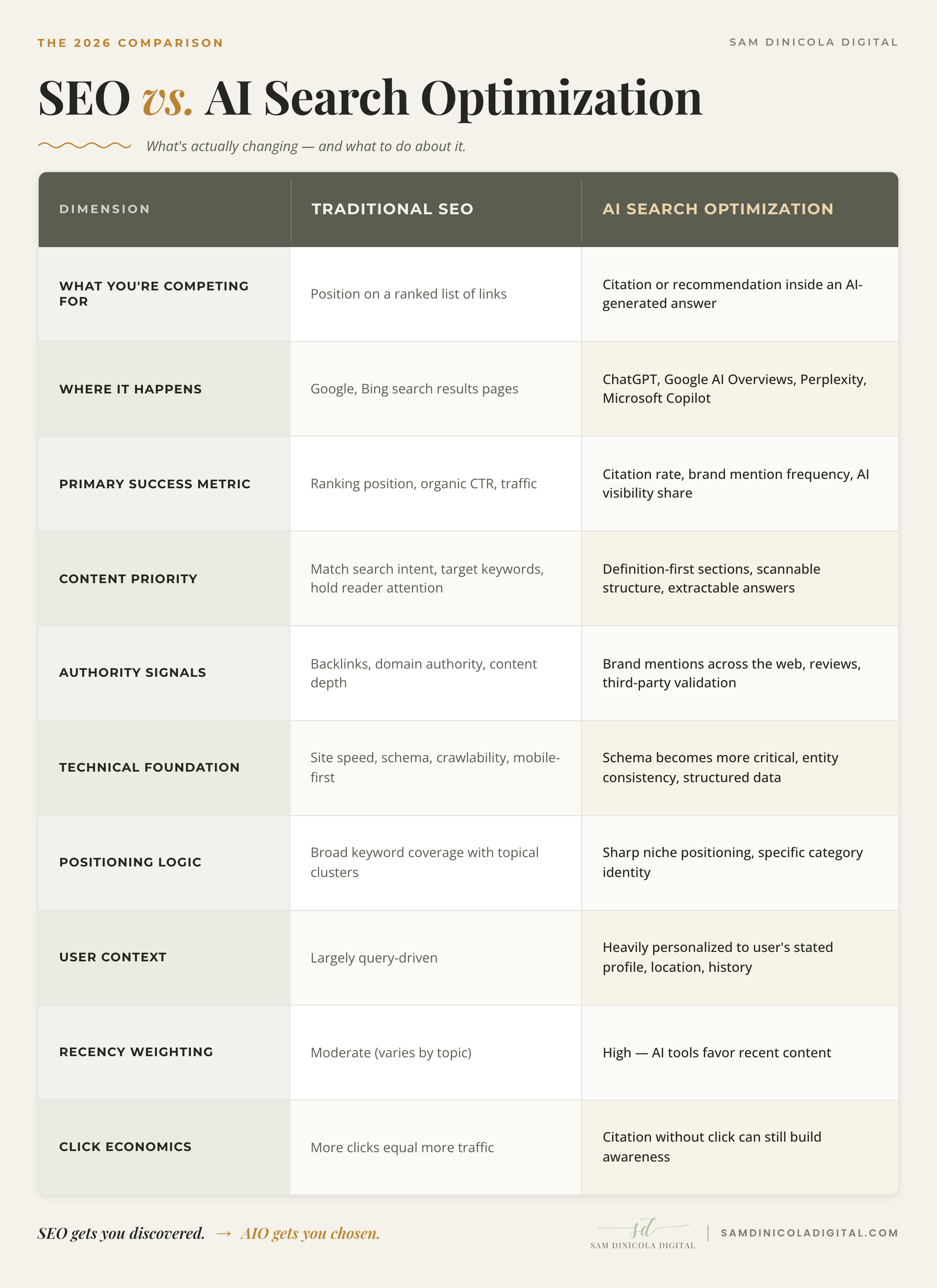
The takeaway: SEO and AI search optimization share infrastructure (technical health, schema, quality content) but diverge on what they ultimately reward. SEO rewards depth and authority signals that earn rank position. AI search optimization rewards extractability, niche clarity, and external brand presence.
What still works from traditional SEO
The fundamentals have not gone anywhere. If anything, several of them now matter more.
Topical authority
A site that consistently publishes about a specific subject still wins. Both Google and AI tools learn to associate domains with topics over time. One blog post does little. A sustained body of work shifts how search engines and AI systems classify your business.
For founder-led service businesses, topical authority is one of the most accessible wins. You already have the expertise. The work is publishing it consistently in a discoverable format.
Technical health and site speed
Crawlable site structure, fast load times, mobile-first design, and clean HTML all still matter. Both Google and AI tools rely on the same underlying web crawlers. If your content can't be efficiently parsed, it can't be ranked or cited.
Search intent matching
Content that directly addresses what the searcher actually wants still outperforms content that approximates the topic. AI tools, like search engines, are getting better at distinguishing between content that answers the question and content that mentions the keywords.
Schema markup
Structured data (FAQ schema, Organization schema, LocalBusiness schema, Article schema) has always helped Google understand your content. AI tools rely on it even more heavily, since schema gives them clean, structured signals about your entity, your offerings, and your authority. This is one of the highest-ROI areas for founder-led businesses to invest in right now.
Backlinks
Quality backlinks from authoritative sites still influence ranking and still serve as a trust signal for AI tools. The relative weight has shifted somewhat, but inbound links from credible sources continue to matter.
What's actually new with AI search optimization
These are the patterns that distinguish AI search optimization from traditional SEO work.
Content has to be extractable
AI tools summarize from the top down. They lift the first clear answer in a section and use it to build their response. Articles that bury the answer in paragraph three rarely get cited, even when the content is excellent. Articles that open each section with a one-sentence direct answer (followed by supporting context) get extracted consistently.
This is a structural shift in how you write. It's also one of the cheapest changes to make to existing content.
Brand mentions matter more than ever
AI tools evaluate businesses partly by how often and how consistently a brand appears across the web. Industry articles, podcast features, guest posts, news mentions, and comparison roundups all build what could be called your AI training footprint. The denser and more consistent your presence across reputable sources, the more likely AI tools recognize you as a real business in your category.
This is a different game than link-building. A mention without a link still counts. A podcast appearance, a quote in an industry article, a feature in a roundup all signal to AI tools that you exist and operate in a specific niche.
Reviews and third-party validation carry significant weight
For B2B businesses, AI tools lean heavily on aggregator signals from platforms like G2, Capterra, and TrustRadius. For service-based and local businesses, Google Business Profile, Yelp, and industry-specific directories matter most. Active review presence on multiple platforms is one of the highest-leverage moves for AI visibility right now.
Sharp niche positioning beats broad positioning
Generalist positioning loses to specific positioning every time in AI recommendations. When a user asks an AI tool for "a marketing agency for health and wellness brands," AI tools surface businesses whose entire web presence reinforces that exact niche. Vague positioning gives AI tools nothing to match against.
Founder-led businesses with strong personal brands have an advantage here. Their content, their case studies, their LinkedIn presence often already reinforce a specific niche. The work is making sure that niche is named clearly and consistently across surfaces.
Recency
AI tools heavily favor information that's current. For fast-moving topics, regular updates matter as much as the original publication date. Older evergreen content still gets pulled, but recent content and fresh angles get extracted more readily.
User context
This is the piece most founders miss. AI tools factor in what they know about the user (stated profession, location, past queries, preferences) when generating recommendations. A founder asking ChatGPT for a marketing agency gets different recommendations than an enterprise CMO asking the same question.
The implication is significant. The clearer your positioning around a specific audience, the more likely AI tools surface you when that audience asks for help. Niche businesses gain ground here, rather than losing it.
Where founder-led businesses get caught
The most common mistake right now is treating SEO and AI search optimization as either/or. You see this two ways.
Some founders abandon SEO entirely, convinced it's been replaced. They stop publishing, ignore their technical foundation, and pour energy into chasing AI visibility without the underlying content infrastructure that AI tools rely on. That backfires. AI tools pull from the indexed web. If you've stopped feeding the indexed web, you've stopped feeding the AI tools.
Other founders ignore AI search entirely, assuming it's a fad or that their customers aren't using these tools. But 73% of B2B buyers now use AI tools in purchase research, and that number is climbing fast. Customers who would have found you through traditional search five years ago may never see you in a traditional result again.
The work right now is both. The infrastructure is largely shared. The optimization layer is where the two diverge. A founder-led business that does this well builds content and brand presence that earns rank position AND gets cited in AI answers, with most of the work reinforcing both surfaces.
What to actually do about it
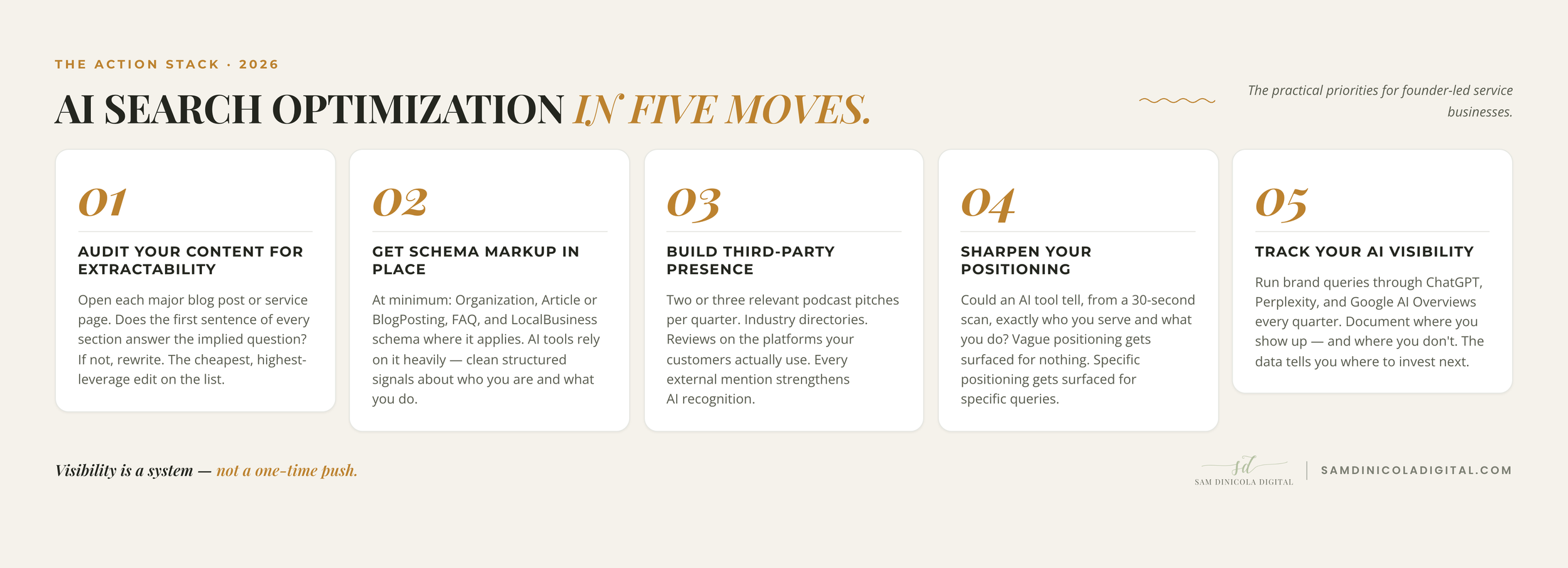
If you're running a founder-led service business at $150K-$500K, the practical priorities are:
1. Audit your top content for extractability. Open each major blog post or service page. Does the first sentence of each section answer the implied question of that section? If not, rewrite. This single change improves AI citation likelihood substantially and costs nothing but editing time.
2. Get schema markup in place. At minimum: Organization schema for your business, Article or BlogPosting schema on your blog posts, FAQ schema where it applies, LocalBusiness schema if you serve a defined geographic area. If you're on a platform like Squarespace, Webflow, or WordPress, this can usually be added through code injection or a plugin.
3. Build third-party presence. Pitch yourself to two or three relevant podcasts per quarter. Get listed in industry directories. Ask for reviews on whatever platforms make sense for your business (Google Business Profile, G2, industry-specific platforms). Each external mention strengthens AI recognition.
4. Sharpen your positioning. Audit your homepage, about page, and service pages. Could an AI tool tell, from a 30-second scan, exactly who you serve and what you do? If your positioning is vague, AI tools will categorize you against vague queries (which means they probably won't surface you at all). Specific positioning gets surfaced for specific queries.
5. Track your AI visibility. Run brand queries through ChatGPT, Perplexity, and Google AI Overviews every quarter. Ask the questions your ideal customer would ask. Are you mentioned? Cited? Recommended? Document where you show up and where you don't. The data tells you where to invest next.
If you want a starting point for the diagnostic, our AI search visibility audit walks through the signs your business may be invisible to AI tools right now and what to check first.
Frequently asked questions
Is SEO dead?
No. SEO is not dead. Around 52% of Google searches still return traditional results without an AI Overview attached, and the underlying work that drives ranking (topical authority, technical health, content quality, and inbound links) is also the foundation for AI search visibility. What's changed is that SEO is no longer the only game. Founder-led businesses now need to optimize for two related but distinct surfaces.
Should I stop doing SEO and only do AI search optimization?
No. The two reinforce each other. AI tools pull from the indexed web, which means the content that ranks in traditional SEO is the same content that gets cited in AI search. Abandoning SEO breaks the foundation that AI search optimization depends on.
How do I know if my business shows up in AI search?
Run the same queries your ideal customer would run through ChatGPT, Perplexity, and Google AI Overviews. Ask things like "best [your service] for [your niche]" or "who can help with [the problem you solve]." If your business does not get mentioned, you are invisible in AI search for that query. If it does get mentioned, note how (cited as a source, named as a recommendation, or both).
What is the difference between AEO and GEO?
Answer Engine Optimization (AEO) and Generative Engine Optimization (GEO) are largely interchangeable terms. AEO leans toward optimizing for direct-answer extraction (getting cited as a source). GEO is broader and includes optimization for AI-generated recommendations and content. Most practitioners use the terms loosely, and the underlying work is the same: structure content for extractability, build brand presence, and reinforce niche positioning.
Do small businesses need to worry about AI search?
Yes, especially service businesses with a defined niche. AI tools tend to favor specific positioning over general positioning, which means a small service business with a clear niche can actually outperform a larger generalist competitor in AI search recommendations. The matching is sharper. The gap closes as your competitors catch on, so the time to start is now.
What this means for you
The shift from SEO to AI search optimization expands the visibility surface rather than replacing it. The fundamentals that drove SEO for two decades (topical authority, content quality, technical health, schema, backlinks) still drive results today. AI search optimization adds a new layer on top of that foundation. It rewards extractability, brand presence, niche positioning, and third-party validation.
For founder-led businesses, this is good news. The work that builds your visibility in AI search is largely the same work that strengthens your business in other ways. Sharper positioning improves your marketing across every channel. A stronger third-party presence creates more referrals and authority signals at the same time. And the structural changes that make your content extractable for AI also make it more useful for the humans reading it.
Visibility is one layer of Growth Architecture, the underlying system for how a founder-led business grows. AI search is the newest piece of that visibility layer. If you want to see how visibility fits into the broader system, our post on what growth architecture actually means walks through all three layers and how they work together.
Want strategic insights like this in your inbox every other week? Subscribe to the bi-weekly newsletter for the next analysis on how founder-led businesses scale beyond the bottleneck.